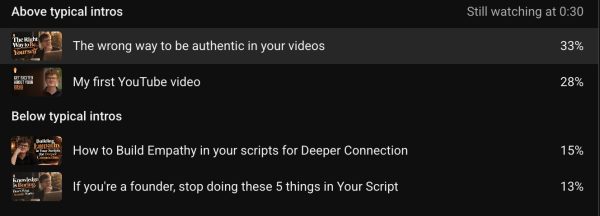
| The state of AI content slop has got me all antsy in my pantsy. I’ve been talking to founders, and I keep hearing this drumbeat of “we’re just going to let AI do the hooks and copy.” I believe this is going to kill innovation, connection and creativity. But there is good news… The business owners who rise above AI slop stand to make a lot of money in the future. So I’m hosting a workshop that helps founders write like humans again, and turn that into people actually buying what you sell on YouTube. We’ll be working with our own scripts to write hooks that boost retention to get more viewers interested in your paid offers. No pitches at the end.No annoying upsells. Just come, write and see what changes.If you’d like to join us, the link is below. Click here to sign up for free today. |
Category: Uncategorized
-

“Electric YouTube Hooks Workshop” is coming up…
-

Hook manipulation and Blues Traveler
There was this song in the 90’s.
It charted at No. 23 on the billboard Top 25
And it did something almost no long had ever done before – It told you why the song was going to chart.
The song was called “The Hook” by Blues Traveler.
The whole point of the lyrics was to show you that the lyrics and substance of the song didn’t matter all that much.
All that mattered was the catchy hook.
Of course, that’s kind of a half truth.
But in this case, the song delivered.
The hook was catchy as hell, and it was one of the most popular songs that year.
Which goes to show you…
If you can create something catchy, it doesn’t always matter if your content is amazing.
It’s about the vibes as much as the content.
The same goes for YouTube scripts.
A lot of the times – especially now on YouTube – everything has already been said.
So if you try and wow people with knowledge, you risk boring them to death.
Now, I’m not suggesting you go full “Blues Traveler” and tell people you’re giving them a hook in your actual YouTube script. Although that might work and I’ve seen YouTube creators do it.
But next time you’re writing a hook, don’t ask “how do I sound smart?”
Ask “what would make me stick around a little longer?”
The hook brings you back. Always.
Until next time.
P.S. I’ve still got the Top 5 YouTube Hooks Working Today guide available for download.
-

Putting stuff in my way
Last weekend, I woke up and walked down to the coffee shop like I do every day.
But on this day, a bunch of people were standing in my way to leave my apartment complex.
When I got outside, someone on a scooter came zipping by the sidewalk, and I had to wait for him to pass.
Then when I was crossing the street, a long line of cars were going by. So I had to wait there.
I finally got to the door of the coffee shop, and lo and behold, there were multiple people standing in the doorway. So I had to be patient there too.
It happens when I’m driving too – I seem to hit every red light when I really want to get somewhere.
It’s funny how I’ve been writing about mental blocks lately and yesterday physical blocks also started to show up.
The work has been put in, and I can slow down for a minute.
Things are moving along outside of me.
It’s why today’s email is shorter than normal as well.
And just like every Sunday, I’m doing my weekly “reality creation” exercise.
This weekly routine helps me get prepared for next week, and appreciate all the things I have today.
Click here to see how it works.
Until next time.
-

How to write electric YouTube Hooks in under 10 minutes
If you’re struggling to write a hook to draw your reader in, consider this.
First, take a step back.
Then ask yourself these 3 questions…
- Who is my target audience?
- What is their desired transformation?
- What’s at stake if they DON’T make this transformation?
For example, my target audience is business founders.
Here’s how I would map this out…
Audience: They feel overwhelmed with the YouTube scriptwriting process. It’s taking too long for them to get a script out. It’s taking away time that they could spend on other things in their business (like actually running the business) or more emotional reasons (like spending time with their family).
Transformation: Their desired transformation is they want a new way to write scripts that’s faster and eliminates overwhelm. They don’t want to sound like a scammer. And they want to eventually hand off the marketing completely so they can spend time with their family. And also draw more people to their sales page where they eventually can become members of their paid community or buy their paid offer.
Stakes: If they don’t solve this, they’ll continue to be overwhelmed and their family life will suffer. They don’t like working late at night or weekends when they could be missing out on a moment with their kids or wife.
Make sure you’re getting real data from your audience and not guessing here.
The goal of this exercise is to get you to stop overthinking.
Now you’ve got the building blocks, and while combining the info might take a little creativity and trial/error, the reality is it’ll be a lot easier now that you have something to work with.
So in my case, I could write something like…
“Writing YouTube scripts isn’t always easy. Sometimes you don’t know what to write. Or you have too much else going on in your business that it can feel overwhelming. This can lead to rushing flat scripts out with AI that just read like slop, and they don’t lead to strong retention rates. Even worse, sometimes you feel like giving up altogether and losing potential clients because they’re not putting themselves out there.
But when you have a system that creates high-retention hooks, you can wake up every day and pump out solid scripts in less than 8 minutes. And keep your retention rates high enough to draw readers to your main offer.
It’s why I came up with this system for devising YouTube Hooks. So let’s dive into it right now.”
That’s just a rough example.
So next time you feel stuck, remember those 3 questions.
It should give you a pathway to writing better hooks that resonate with your audience.
Hope that helps.
P.S. I just released “Top 5 YouTube Hooks I see working now.” You can use these as templates if you get stuck.
-

My most addicting process for energizing writing
This is a process that I still use to create unique hooks and write prolifically.
I credit this process with helping me scale my newsletter to 40k a week when I worked at Oxford Club.
-

Want to write more YouTube scripts? Beware of these 3 limiting beliefs
Anytime I sit down to write a script, these 3 beliefs often creep into my brain.
But once I’m aware of them, I can start writing faster and with better quality.
-

“It’s almost embarrassing”
The other day I was on a call with a business founder.
It was the same person who pointed out my crazy note taking in my last article.
He wanted to show me his emails.
So he pulled up his screen, and said something that stuck with me.
“It’s almost embarrassing how many typos I have.”
And he was right.
There were a lot of typos in his emails.
The funny thing is…
I didn’t even notice.
His content was so good.
He was talking about all the cool stuff he was doing.
Making people money, the projects he was working on, and leading his customer into his next offer.
It was all so exciting.
And even with all the typos, the amount of responses he got for his offer were incredible.
Multiple emails back… people saying they’d been following him for a long time and wanted to work with him.
It was a great lesson, and it reminded me that perfectionism destroys.
The actual content matters, of course. You don’t want to look like a complete idiot. And maybe he could spend a little more time editing.
But nobody cares.
I can take many examples from my own writing.
When I ghostwrite for founders, I notice sometimes they want to obsess over looking like an expert.
They want to talk about all these numbers and stats and data.
I get it.
But the truth is people are going to buy from you because of how you make them feel more than anything.
Your energy.
Your enthusiasm.
How different you are.
And most importantly – how you show up consistently in that high energy state.
Yes, you still have to deliver value.
But when you’re not bogged down by perfectionism, I often notice that’s when you get the best results. Meaning more customers who are excited to work with you.
Until next time.
-

When I’m my own bottleneck
My basic bro Trello board.
The other day I was on a call with a founder discussing an upcoming workshop I’m working on.
The founder asked me what the workshop was about.
I gave him a vague answer, and then I told him all my notes are on my Trello board.
“Well, let’s see your Trello board” he says.
I shared my screen to show him my board, and I could feel a tone shift on the Zoom call once he laid eyes on it.
“Woah,” he says.
“You have so many notes here.”
I sheepishly told him that yes I do take a lot of notes.
“Do you think that’s going to be easy for you to come up with ideas with that many notes?”
I already knew the answer was no.
I mean, take a look for yourself…

Behold the overwhelm You see…
As a creative, I’m constantly trying to capture new and exciting ideas.
The problem with that is I end up taking so many notes.
These word dumps can lead to analysis paralysis.
And then I don’t actually process the notes into actual decisions.
This hurts my ability to launch offers, workshops, guides, or anything else that could actually make me money.
Ouch.
This was clearly holding me back.
So we immediately simplified things.
I created a basic bro Trello board with three cards.
– Ideas
– In progress
– Done
One constraint I added…
I don’t put more than 2 things in the “in progress” section.
This allows me to focus so I don’t get overwhelmed or fall into workaholism.
I created 3 boards, one for workshops, one for emails and one for YouTube scripts.
Check it out below.

As you’ll see above, this new board is much cleaner.
I’m using it starting today and will report back on how it helps. I already imagine it’ll be much better.
And I must ask…
As a creative, do you struggle with having too many notes and not knowing what to do with them?
How does that impact your ability to write clearly?
Let me know by clicking REPLY below.
Until next time.
-

Why 15k a month (If I was purely selfish)
Last month I made a business intention that I will generate 15k a month.
I keep coming back to it again and again.
Why do I want this much money?
What’s the point?
But the number isn’t the important part.
It’s easy when I go to business events and hear about people saying “I’m scaling my business and making $100,000 a year” and then I think I want that too.
But I found when I really step away and get specific, then I start to understand what I really want.
So here’s what 15k allows me to do…
It prevents me from having to drop everything I’m doing and go do a favor from a boss who’s going to pay me a little bit of overtime, much of which will just get taxed away anyway.
I can go travel to a few places each month. I hate flying and car rides make me sick, but I like experiencing new environments every once in a while, so I don’t need a ton for that.
I can go to a restaurant and not worry about the bill.
I can buy high-quality food.
I can get a gym membership and stay in shape.
I can train Brazilian Zouk regularly.
I can support my inspirational artist friends.
I can do more deprivation therapy to stay relaxed.
I can travel south during the winter to avoid seasonal depression.
I can invest in programs to sharpen my skills and deliver better content for my clients.
Even as I type this, my shoulders are dropping.
I’m feeling more relaxed.
It’s sitting well in my body.
This is a sign that it’s actually motivating for me.
You’re not going to see some advertisement with a guy in a float tank talking about how he’s going to hustle to make 15k a month.
This is not hardcore aspirational poster material.
It’s just what I want.
It’s specific to me.
And that’s the point.
But the next question is then how do I make this money without destroying my soul (a mistake I’ve made many times).
Well, I need constraints.
I need to be able to get this work done in a way that’s fulfilling to me.
That doesn’t mean I’m always going to be happy all the time or whatever.
It just means I’m genuinely enjoying the process and it’s energizing me.
For me, I hate sales calls.
So I’d like to avoid those as much as possible.
So I’ll have to create offer documents.
I’ll also need at least 3 days a week to create offers.
It’d be nice to have 52 offers per year (1 a week for my audience).
Also, I hate blasting social media feeds. So I won’t be posting on social media all day.
I also won’t be working with founders who want to use Claude and ChatGPT before discovering what their unique brand voice is. I’ll be willing to hand hold for as long as possible since not every founder gets this right away. But understanding personal voice is a vital part of the process for capturing strong engagement, especially in the AI age.
I work with founders who care about their creative expression and want to express that through their business.
I’ve found that the more specific and unique my intention is, the harder it motivates me to work, and the better my odds at actually fulfilling it.
Until next time.
-

Chasing the elusive “carebear” badge
This past weekend I attended a Brazilian Zouk connection-based intensive in Washington DC.
If you’re unfamiliar, Brazilian Zouk is a social partner dance that emerged in Brazil in the early 1990s.
The goal was to make our dance feel truly “good.”
And there were several badges we could earn based on how well we displayed the following traits…
- Adaptability
- Comfort
- Floorcraft
- Musicality
- Smell
- Presence and Playfulness
As for my own goals, I wanted the “carebear” badge, which goes to those who scored consistently high in the “comfort” category.
But I wasn’t graded on my technique.
I was graded on how well these traits resonated.
It was about seeing how well my partner could feel me.
And each time we danced with someone, we’d give them a score on each trait using the resonance scale below…
- Quiet resonance (where connection was barely felt).
- Soft resonance (connection felt briefly but not consistently).
- Emerging resonance (more consistent, almost consistent throughout).
- Clear resonance (very enjoyable and comfortable throughout).
- Strong resonance (going beyond consistency and into unique creativity, depth and personality).
- Deep resonance (a seamless adaptation of emotional tone that adds more nuance and confidence, leaving a lingering impression).
- Unforgettable resonance (being beyond physical to the point of wow).
Most of my dances fell in-between soft-clear on the resonance.
I did have one strong resonance dance that I was really proud of though.
But I’m still chasing the elusive “carebear” badge.
Here’s the thing I noticed though.
It wasn’t a skill problem.
I’ve been dancing Zouk for a long time. I know the steps. I’ve even had two dances I’d grade on the unforgettable scale (based on my own subjective interpretation). So I have an idea of what high resonance actually feels like.
But at times during the event, I noticed I was on autopilot a lot. I wasn’t as present or relaxed as I could be.
And I would see a direct correlation between the times I was on autopilot and the times I scored lower.
I noticed this is also true when I’m writing.
For example, when I sat down to write a finance email for Karim Rahemtulla at Oxford Club about how he hated crypto and was done trading it, I knew exactly what I wanted to say. That email had very few edits and was one of the most engaged with emails that week.
It’s the same in my own writing.
When I know what I want to say…
When I know my brand voice inside and out…
When I actually understand what my audience needs from me in that moment, then the writing comes out smoother.
There’s a real energetic charge behind it.
The best part from a business angle is the writing performs better too.
More people open the emails.
More people respond in the comments.
And if they’re ready, they’re more likely to buy.
Even if the writing isn’t “technically” perfect.
So if you want to start writing from a place of deeper resonance more consistently, I encourage you to check out The 2-Minute Writing Spark.
It’s a guide I created for the purpose of finding ideas that resonate most with you. All in just 2 minutes a day.
You’ll learn…
- How to get ideas flowing without forcing them
- How to find the ideas that actually make you want to keep writing
- The real reason most writers get blocked, and how to stop hitting that wall
- How to never run out of things to write about
All in a simple 8-page guide.
Keep in mind, The 2-Minute Writing Spark is NOT a copywriting book. It’s designed to change your relationship to writing from “ugh I gotta do this” to a deep, embodied process to connect with yourself.
Click here to download the 2-Minute Writing Spark today.
To less autopilot and more resonance.